


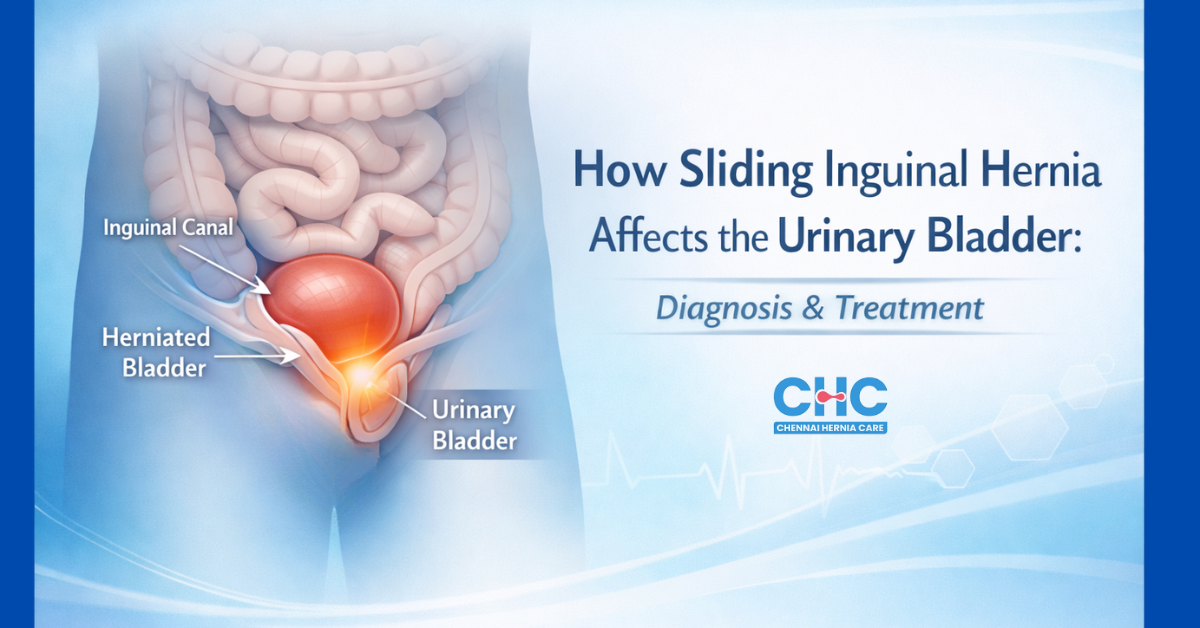
At Chennai Hernia Care, led by Dr Deepak Subramanian, a leading hernia specialist in Chennai, we often see complex cases such as sliding inguinal hernia, a less common but clinically significant type of groin hernia. Unlike regular inguinal hernias, where fat or intestine pushes through a weak spot in the abdominal wall, a sliding inguinal hernia involves an organ itself forming part of the hernia wall.
One of the most significant and clinically meaningful forms is a hernia of the urinary bladder, where part of the bladder slides into the inguinal canal (the natural passage in the lower abdomen). When the bladder is involved, symptoms may affect urination and overall comfort, making early diagnosis and proper treatment essential.
What Is a Sliding Inguinal Hernia?
A sliding inguinal hernia occurs when part of an internal organ, most commonly the urinary bladder, colon, or intestine, slides into the inguinal canal and forms part of the hernia sac.
How It Is Different from Other Inguinal Hernias
- Regular inguinal hernia: Only tissue or intestine bulges out
- Sliding inguinal hernia: An organ itself (such as the bladder) is involved
In cases of sliding inguinal hernia, bladder involvement, the bladder wall becomes part of the hernia. This makes diagnosis and surgery more complex.
Common Causes and Risk Factors
Risk factors include:
- Older age (more common in men over 50)
- Chronic straining during urination (often due to prostate enlargement)
- Obesity
- Chronic cough
- Previous inguinal hernia
- Weak abdominal muscles
How Does a Sliding Inguinal Hernia Affect the Urinary Bladder?
In a sliding inguinal hernia involving the bladder, part of the urinary bladder slowly moves into the inguinal canal over time. This usually occurs due to long-standing pressure within the abdomen, combined with weak supporting tissues.
The bladder does not entirely leave its normal position; instead, it becomes stretched and partially displaced.
Potential Complications
When the bladder is involved, several complications may occur:
- Bladder obstruction (blockage of urine flow)
- Urinary retention (inability to empty the bladder fully)
- Recurrent urinary tract infections (UTIs)
- Bladder injury during surgery, if unrecognised
In rare cases, delayed treatment can affect kidney function due to prolonged urine blockage.
Pain and Discomfort
Patients may experience:
- Groin pain that worsens when the bladder is full
- Discomfort during urination
- Relief of groin swelling after urination (a classic but uncommon sign)
Signs and Symptoms: How to Identify a Sliding Inguinal Hernia
Visible Signs
- Bulge or swelling in the groin
- Swelling increases with coughing, lifting, or straining
- Hernia may reduce (go back in) after lying down
Symptoms Related to the Urinary Bladder
When bladder involvement is present, symptoms may include:
- Difficulty starting urination
- Frequent urination
- Feeling that the bladder does not empty completely
- Two-stage urination (needing to press the groin to finish urinating)
Pain or Discomfort
- Dull or aching pain in the groin or lower abdomen
- Pain increases with activity
- Discomfort related to bladder filling
How It Can Go Unnoticed
Many patients mistake symptoms for:
- Urinary tract infection
- Prostate problems
- General muscle strain
Because symptoms develop slowly, diagnosis is often delayed.
Who Is at Higher Risk?
- Older men
- Patients with an enlarged prostate
- Individuals with chronic urinary problems
- Those with previous hernia repairs
Challenges in Diagnosing Sliding Inguinal Hernia with Bladder Involvement
Why Diagnosis Is Difficult
Sliding inguinal hernias are often missed during routine physical exams because:
- The hernia may be small
- Symptoms are vague
- Bladder involvement is not always suspected
Delayed diagnosis increases the risk of complications such as bladder injury during surgery.
Diagnostic Methods
Doctors may use:
- Physical examination
- Ultrasound (uses sound waves to visualise organs)
- CT scan (detailed cross-sectional imaging)
- MRI (advanced imaging for complex cases)
At Chennai Hernia Care, Dr Deepak Subramanian uses advanced imaging such as ultrasound and CT scans to diagnose sliding inguinal hernias involving the urinary bladder, ensuring accurate and safe treatment planning.
Risks of Delayed Diagnosis
- Bladder strangulation (loss of blood supply)
- Acute urinary retention
- Increased surgical complications
Treatment Options for Sliding Inguinal Hernia Involving the Urinary Bladder
Conservative Management
In mild cases with minimal symptoms:
- Watchful waiting
- Avoiding heavy lifting
- Managing constipation
- Treating prostate enlargement
However, conservative treatment is usually temporary.
Surgical Treatment (Definitive Management)
Sliding inguinal hernia surgery is the definitive treatment, especially when the bladder is involved.
The goals of surgery are:
- Safely repositioning the bladder
- Repairing the hernia defect
- Preventing recurrence
Open Surgery vs Laparoscopic Surgery
Open Surgery
- Traditional approach
- Better visualization in complex bladder cases
- Often preferred for large or long-standing hernias
Laparoscopic Surgery (minimally invasive surgery using small cuts and a camera)
- Faster recovery
- Less pain
- Requires experienced surgeons when bladder is involved
The best treatment for hernia with bladder involvement is surgical repair. At Chennai Hernia Care, Dr. Deepak Subramanian, one of the best hernia surgeons in Chennai, performs both open and laparoscopic repairs depending on the patient’s condition.
Complexity and Risks of Surgery
Because the bladder is involved, risks include:
- Accidental bladder injury
- Temporary urinary catheter use
- Post-operative urinary retention
These risks are minimized with proper pre-operative imaging.
Post-Surgery Care
After sliding inguinal hernia repair, patients may need:
- Temporary urinary catheter
- Pain control
- Activity restriction for 4–6 weeks
- Follow-up imaging if needed
Most patients recover well with proper care.
Complications of Sliding Inguinal Hernia Involving the Urinary Bladder
Urinary Retention or Obstruction
A herniated bladder can block urine flow, leading to:
- Painful bladder distension
- Infections
- Kidney stress
Strangulation or Incarceration
- Incarceration (hernia stuck and cannot be pushed back)
- Strangulation (cut-off blood supply)
These are surgical emergencies.
Impact on Kidney Function
A long-standing obstruction can affect kidney health if left untreated.
Preventing Sliding Inguinal Hernias: Can It Be Avoided?
While not always preventable, risk can be reduced by:
- Avoiding heavy lifting
- Treating chronic cough
- Managing constipation
- Maintaining a healthy weight
- Treating prostate enlargement early
Early detection is key to preventing hernia complications.
When to Seek Medical Help
Seek medical attention if you notice:
- Groin swelling with urinary symptoms
- Difficulty urinating along with groin pain
- Sudden pain, redness, or fever
- Inability to pass urine
Early intervention prevents serious complications.
Conclusion: The Importance of Timely Diagnosis and Treatment
A sliding inguinal hernia involving the urinary bladder is uncommon but clinically important. Because symptoms can mimic urinary or prostate problems, diagnosis is often delayed.
Understanding the warning signs, using appropriate imaging, and opting for timely sliding inguinal hernia treatment, especially surgical repair, can prevent serious complications such as bladder damage, urinary obstruction, and kidney problems.
Early diagnosis and expert surgical care ensure the best outcomes and improved quality of life.
Book a consultation today for a personalised diagnosis and the best hernia treatment in Chennai.
References: StatPearls | Cleveland Clinic | Radiopaedia | Urology Case Reports | European Radiology | NHS | National Kidney Foundation | American Urological Association
Frequently Asked Questions
A sliding inguinal hernia occurs when part of an internal organ, usually the urinary bladder, colon, or intestine, protrudes into the inguinal canal through the hernia sac. It’s less common but more complex than a regular inguinal hernia.
A sliding hernia refers to a type of hernia where an organ itself becomes part of the hernia wall. In the groin area, this often involves the bladder or colon sliding through a weak spot in the abdominal wall.
No, a sliding inguinal hernia does not heal on its own. Because an organ like the bladder or intestine is involved, surgery is the only definitive treatment to prevent complications such as obstruction or strangulation.
A sliding inguinal hernia is repaired through surgery — either open or laparoscopic. The goal is to safely reposition the organ (e.g., the bladder), repair the weakened area of the abdominal wall, and prevent recurrence. At Chennai Hernia Care, Dr. Deepak Subramanian specializes in complex hernia repairs using minimally invasive methods.
People with a sliding or inguinal hernia should avoid heavy lifting, straining, or intense exercise that increases abdominal pressure. Managing constipation, maintaining a healthy weight, and treating chronic cough can help prevent worsening of the hernia.

Our Medical Review Process:
Our content goes through a structured review process to ensure medical accuracy and reliability.
Written By: Editorial Team, Chennai Hernia Care
Reviewed By: Dr. Deepak Subramanian, MS, FMAS – Laparoscopic & Bariatric Surgeon
Last Updated: October 13, 2025
