


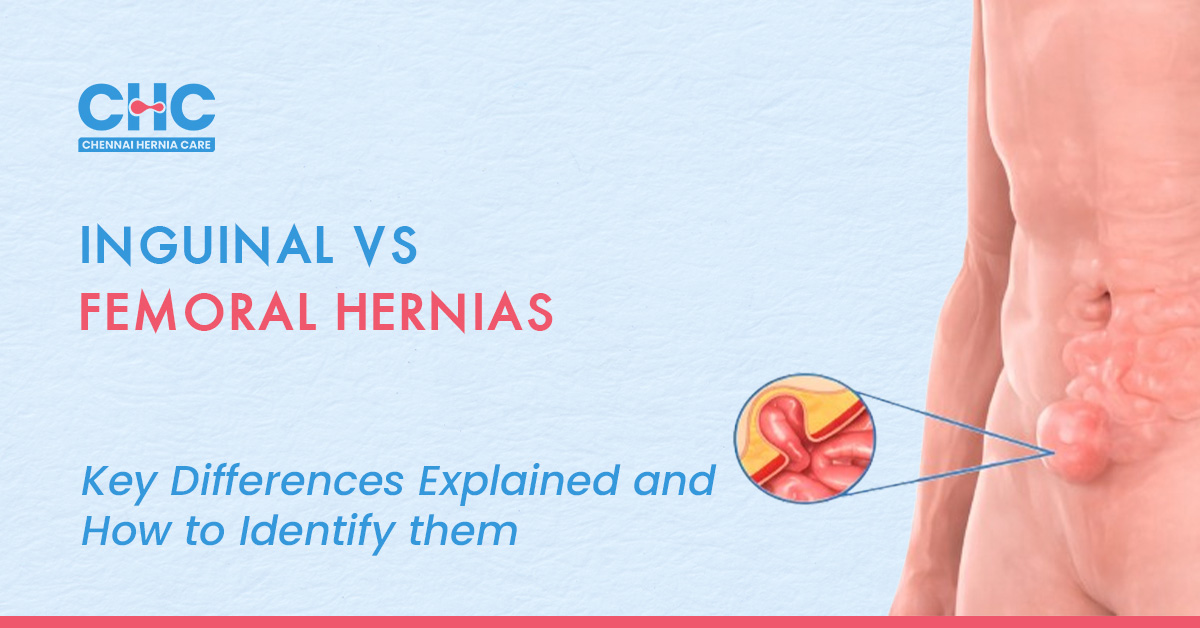
When patients search for ‘femoral vs inguinal hernia,’ they are often trying to understand the differences between the two, especially when experiencing groin pain or swelling. Although both conditions occur in the same region, their anatomy, risk profiles, and treatment urgency can vary significantly.
At Chennai Hernia Care, under the expertise of Dr. Deepak Subramanian, we frequently evaluate patients who are unsure whether they have a femoral or inguinal hernia. This guide explains the key differences in location, symptoms, diagnosis, and treatment, helping you make informed decisions about your health.
What Are Groin Hernias and Why Should You Care?
Groin hernias are among the most common abdominal wall hernias. The two primary types are inguinal and femoral hernias, and understanding their differences is important for early diagnosis and treatment.
Inguinal and Femoral Hernia: Key Differences at a Glance
If you are searching for the femoral vs inguinal hernia difference, here is a quick comparison:
| Feature | Inguinal Hernia | Femoral Hernia |
| Location | Upper groin, above the inguinal ligament | Lower groin, below the inguinal ligament |
| Canal Involved | Inguinal canal | Femoral canal |
| More Common In | Men | Women |
| Risk of Strangulation | Lower | Higher |
| Visibility | Larger, more noticeable bulge | Small, subtle bulge |
| Urgency | May be monitored | Usually requires early surgery |
This table directly answers common queries like:
- The difference between an inguinal hernia and a femoral hernia
- femoral and inguinal hernia difference
- inguinal vs femoral hernia location
Anatomy 101: Femoral Canal vs Inguinal Canal
Understanding the anatomical difference helps differentiate these conditions.
Inguinal Hernia: The More Common Culprit
Inguinal hernias occur in the inguinal canal, a natural passage in the lower abdominal wall. This canal allows structures like the spermatic cord (in men) to pass through.
Risk factors include:
- Wider inguinal canal structure in men
- Chronic cough
- Heavy lifting
- Increased abdominal pressure
If you want detailed symptom guidance, read: Inguinal Hernia Symptoms: When to Seek Medical Help
Femoral Hernia: The Subtle but Riskier Condition
Femoral hernias pass through the femoral canal, located just below the inguinal ligament and closer to the upper thigh.
These are:
- Less common
- More frequent in women
- Higher risk of obstruction and strangulation
Because femoral hernias are small and deep, they are often misdiagnosed as inguinal hernias.
Learn more here: Femoral Hernia Symptoms Explained
Femoral vs Inguinal Hernia Location: How to Tell the Difference
A common patient question is: How do you differentiate between an inguinal and a femoral hernia? The key lies in anatomical location and clinical examination.
Clinical Location Difference
- Inguinal hernia → The swelling appears above the groin crease, closer to the lower abdomen and pubic region.
- Femoral hernia → The swelling appears below the groin crease, slightly toward the upper thigh.
This location-based distinction is one of the most reliable ways for doctors to distinguish a femoral hernia from an inguinal hernia during physical examination.
Femoral Canal vs Inguinal Canal (Anatomical Difference)
- Inguinal hernias pass through the inguinal canal
- Femoral hernias protrude through the femoral canal, located just below the inguinal ligament
Because the femoral canal is narrower and deeper, femoral hernias are often smaller but carry a higher risk of strangulation.
Imaging: How Radiology Confirms Femoral vs Inguinal Hernia
When physical examination is inconclusive, imaging helps confirm the diagnosis.
- Ultrasound – First-line investigation; useful in detecting both inguinal and femoral hernias
- CT Scan – Clearly shows whether the hernia sac is above or below the inguinal ligament
- MRI – Provides detailed soft tissue evaluation in complex or recurrent cases
Symptoms: Femoral Hernia vs Inguinal Hernia
Although both conditions present as groin hernias, the severity and risk profile can differ. Understanding the symptom pattern helps in identifying the difference between a femoral and an inguinal hernia early.
Inguinal Hernia Symptoms
Inguinal hernias usually develop gradually and are more visibly noticeable.
- Visible swelling in the upper groin area
- Discomfort or heaviness while standing for long periods
- Burning, aching, or pulling sensation
- The bulge becomes more prominent while coughing, straining, or lifting
Femoral Hernia Symptoms
Femoral hernias are often smaller but potentially more dangerous.
- Small, deep lump in the lower groin or upper thigh
- Sharp pain during bending, lifting, or sudden movements
- Sudden severe pain if strangulation occurs
- Higher risk of intestinal obstruction compared to an inguinal hernia
Critical alert: Sudden severe pain, nausea, vomiting, or an irreducible bulge indicates strangulation — seek emergency care immediately.
Treatment: Does Femoral vs Inguinal Hernia Management Differ?
Yes, treatment urgency differs.
Inguinal Hernia Treatment
- Observation in selected cases
- Open mesh repair
- Laparoscopic repair
- Faster recovery in minimally invasive surgery
Understand recovery better here: Recovery After Inguinal Hernia Surgery: What to Expect
Post-surgery care guides:
Femoral Hernia Treatment
Femoral hernias usually require early surgical repair because of a higher strangulation risk.
Laparoscopic repair is often preferred for:
- Faster healing
- Reduced complications
- Better visualization of femoral canal
When Is It an Emergency?
Immediate medical care is required if:
- Sudden intense groin pain
- Redness or discolouration
- Bulge becomes non-reducible
- Fever with abdominal pain
- Vomiting or obstruction symptoms
Why Choose Chennai Hernia Care?
Under the expertise of Dr. Deepak Subramanian, patients receive:
- Advanced groin hernia evaluation
- Accurate differentiation between inguinal and femoral hernia
- Minimally invasive surgical solutions
- Personalised post-surgery care
If you are unsure whether you have a femoral or an inguinal hernia, early evaluation can prevent complications.
Frequently Asked Questions
The primary difference is location. Inguinal hernias occur above the inguinal ligament in the inguinal canal, while femoral hernias occur below it in the femoral canal and have a higher complication risk.
Yes. Femoral hernias have a higher risk of strangulation and usually require earlier surgery.
Yes. Ultrasound and CT scans clearly show whether the hernia passes through the femoral canal or the inguinal canal.
Inguinal hernias are far more common, especially in men.

Our Medical Review Process:
Our content goes through a structured review process to ensure medical accuracy and reliability.
Written By: Editorial Team, Chennai Hernia Care
Reviewed By: Dr. Deepak Subramanian, MS, FMAS – Laparoscopic & Bariatric Surgeon
Last Updated: February 27, 2026
