


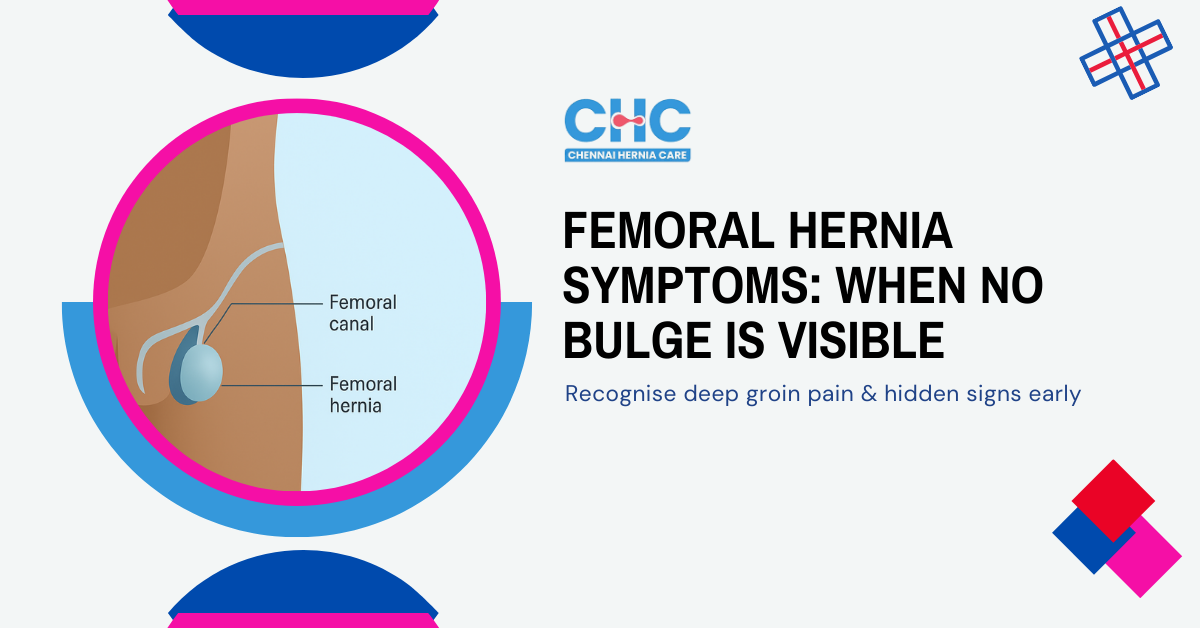
Many people think a hernia always comes with a visible lump but that’s not true for femoral hernias. Because they lie deep in the femoral canal, femoral hernia symptoms can be subtle or even completely hidden. That makes early recognition critical.
Ignoring these symptoms can lead to serious complications like a strangulated femoral hernia, where blood supply to trapped tissue is cut off. That’s why it’s important to know what to look for even if there’s no noticeable bulge.
If you’re in Chennai and worrying about persistent groin or thigh discomfort, being informed can help you decide whether to consult a hernia specialist in Chennai. At Chennai Hernia Care, we prioritize patient education and prompt assessment for peace of mind.
What Is a Femoral Hernia?
A femoral hernia happens when soft tissue, often a loop of intestine, pushes through a weak spot into the femoral canal, a narrow area just below the groin. Unlike inguinal hernias, which are more common, femoral hernias are rare and more common in women.
Because of the tight space, even a small hernia in the femoral canal can be risky. The femoral hernia anatomy is complex, and the hernia can quickly become trapped, leading to pain or more serious issues.
What Causes a Femoral Hernia?
Here are some of the common femoral hernia causes:
- Chronic coughing
- Straining when passing stools (constipation)
- Heavy lifting or physical labor
- Pregnancy or childbirth
- Genetic or connective tissue weakness
- Being overweight or under constant abdominal pressure
These factors increase pressure on the muscles around the femoral canal, increasing the likelihood of a hernia.
Hidden Femoral Hernia Symptoms (Even Without a Bulge)
You might wonder: Can I have femoral hernia symptoms without a lump? Yes, many people do.
Some of the most common signs include:
- A deep ache or pressure in the groin
- Pain in the upper thigh (especially the inner thigh)
- Burning or tugging sensations when standing, walking, or straining
- Heaviness or dragging feeling around the groin
- Nausea, mild abdominal discomfort, or digestive changes, if things worsen
At Chennai Hernia Care, we respect each patient’s journey. Whether you’re leaning toward surgery or prefer a monitored, conservative path, our hernia clinic offers personalized evaluation and guidance.
Diagnosing a Hidden Femoral Hernia
Since there may be no visible lump, doctors often rely on:
- Careful physical examination, checking for subtle tenderness or bulges while standing or coughing.
- Ultrasound is often the first-line imaging tool.
- CT scan or MRI, especially when the diagnosis is not clear on ultrasound.
If a hernia is suspected, especially in women or cases where imaging is ambiguous, studies show that unsuspected femoral hernias are fairly common. A PubMed-indexed study found that nearly 9.2% of patients having surgery for what was thought to be recurrent inguinal hernia actually had a femoral hernia that wasn’t diagnosed beforehand. Another recent analysis revealed that minimally invasive surgery (MIS), like laparoscopy, finds femoral hernias more frequently in women than open surgery does.
Treatment: What Are Your Options?
Once diagnosed, femoral hernia treatment typically involves surgical repair. Why? Because the risk of strangulation is higher for femoral hernias.
Surgical Approaches
- Open Repair: Traditional surgery with a groin incision.
- Laparoscopic/Robotic Repair: Minimally invasive, with smaller incisions and a quicker recovery.
- Mesh or Non-Mesh Repair:
- Mesh-based repairs are common and durable.
- Some centers specialize in mesh-free femoral hernia repair, which may appeal to patients wary of permanent implants.
Emergency Surgery
If there are signs of a strangulated femoral hernia, sudden severe pain, nausea, vomiting, or redness urgent surgery is essential.
At Chennai Hernia Care, our team offers both mesh-based and minimally invasive options for hernia surgery, backed by experienced hernia specialists in Chennai.
Anatomy & Boundary: Why Femoral Hernias Are High-Risk
The femoral canal is a tightly confined space bordered by:
- Inguinal ligament (front)
- Lacunar ligament (medial)
- Femoral vein (lateral)
- Pubic bone / Cooper’s ligament (back)
Because of these femoral hernia boundaries, even small hernias can get trapped, making complications like strangulation more likely than in some other hernia types.
Prevention & Self-Care Tips
You can’t always prevent a femoral hernia, but you can reduce your risk and manage symptoms:
- Avoid chronic straining during bowel movements
- Maintain a healthy weight
- Strengthen your core gently (under medical guidance)
- Use proper lifting techniques
- Treat persistent coughs
If you have a diagnosed femoral hernia and surgery isn’t urgent, our hernia clinic in Chennai can help you set up a regular monitoring plan.
Conclusion
Hidden femoral hernias, especially when there’s no visible bulge, can be both confusing and risky. Because of the anatomy of the femoral canal, even small hernias deserve careful attention.
Hearing from real patients reminds us: surgical decisions are deeply personal. Some choose to wait, others prefer early repair. What matters most is being fully informed and working with a trusted hernia specialist.
If you’re experiencing groin or upper-thigh pain, or simply want reassurance, consider booking a consultation with us at Chennai Hernia Care. Early evaluation can bring clarity, peace of mind, and prevent complications, especially when guided by the best hernia surgeon in Chennai dedicated to providing safe, evidence-based care.
References
- Cleveland Clinic: Femoral Hernia Overview
- PubMed: Unsuspected Femoral Hernia in Recurrent Inguinal Hernia
- PubMed: Revisiting Femoral Hernia Diagnosis Rates by Sex
- HerniaInfo: Risk Factors & Anatomy Guide
Frequently Asked Questions
Gently feel the base of your groin while standing and straining or coughing. Press lightly if there is pain or pressure, mention it to your doctor.
This is a clinical test where a doctor places three fingers along the groin crease, assessing any unusual movement or tenderness when you cough or strain.
Unfortunately, no. While lifestyle changes may ease discomfort, surgery is the only way to repair the defect permanently.
Seek medical attention if you get sudden, severe groin or thigh pain, nausea, or swelling these may signal a strangulated hernia.
Pain may be in the groin crease, upper inner thigh, or sometimes around the pelvic region, especially when standing or straining.

Our Medical Review Process:
Our content goes through a structured review process to ensure medical accuracy and reliability.
Written By: Editorial Team, Chennai Hernia Care
Reviewed By: Dr. Deepak Subramanian, MS, FMAS – Laparoscopic & Bariatric Surgeon
Last Updated: January 14, 2026
